The aesthetics industry in Pakistan continues to attract people interested in skincare, beauty therapy and advanced aesthetic practice. As technology develops, professionals can learn about a wide range of treatments designed to improve skin appearance and address different cosmetic concerns.
However, aesthetic dermatology courses in Pakistan can vary considerably. Some programs focus on non-invasive skincare and beauty treatments, while others are designed for qualified healthcare professionals who want additional training in clinical aesthetic procedures.
Therefore, choosing a course based on your educational background, career goals and permitted scope of practice is essential.
Cosmothetics Academy in Lahore currently describes its training as expert-led education covering invasive, non-invasive and cosmetology practice. Its website also states that much of the training involves supervised practical work rather than classroom theory alone.
What Are Aesthetic Dermatology Courses?
Aesthetic dermatology courses are educational programs focused on the science and practical application of aesthetic skin treatments.
Depending on the level of the program, subjects may include:
- Skin anatomy and physiology
- Skin types and conditions
- Skin analysis
- Facial treatments
- Chemical peels
- Microneedling
- Skin rejuvenation
- Laser and light-based technologies
- Acne and pigmentation management
- Cosmetic consultation
- Infection prevention
- Client or patient assessment
- Treatment planning
- Post-treatment care
- Advanced aesthetic procedures
The exact curriculum differs from one academy to another.
A short aesthetic course should not automatically be treated as equivalent to a medical degree, dermatology specialization or recognized postgraduate medical qualification.
Aesthetic Dermatology vs. Dermatology
The terms aesthetic dermatology and dermatology are related but should not be used interchangeably.
Dermatology
Dermatology is a medical specialty concerned with diagnosing and managing diseases and conditions involving the skin, hair and nails.
Aesthetic Dermatology
Aesthetic education can teach techniques and treatment principles, but completing a private training course does not by itself make someone a dermatologist or medical doctor.
For people seeking formal medical specialization, recognized medical education and postgraduate pathways are separate from short private aesthetic courses. PM&DC’s current regulations and qualification information distinguish recognized medical and postgraduate qualifications from other forms of training.
Why Study Aesthetic Dermatology in Pakistan?
Students and professionals may choose aesthetic training for several reasons.
Growing Interest in Skin Care
People increasingly seek professional solutions for concerns such as:
- Acne
- Acne scars
- Pigmentation
- Uneven skin tone
- Fine lines
- Sun damage
- Skin texture
- Unwanted hair
- Skin aging
This has increased interest in professionals who understand modern skincare and aesthetic technologies.
Development of Aesthetic Technology
Modern aesthetic practice can include different technologies and techniques.
Depending on the student’s qualification and course level, training may cover technologies such as:
- Laser systems
- Fractional laser
- HIFU
- Radiofrequency
- LED/light-based treatments
- Microneedling
- HydraFacial-type procedures
- Chemical peels
Students should always verify which procedures are actually included in a particular curriculum.
Practical Career Skills
Structured training can help learners develop theoretical knowledge, technical understanding, consultation skills and professional hygiene practices.
However, career opportunities and permitted professional activities depend on the learner’s underlying qualification, applicable regulations and employer requirements.
What Do You Learn in Aesthetic Dermatology Courses?
A comprehensive course can cover several areas.
1. Skin Anatomy and Physiology
Students first need a foundation in skin structure and function.
Topics may include:
- Epidermis
- Dermis
- Subcutaneous tissue
- Collagen
- Elastin
- Sebaceous glands
- Hair follicles
- Skin barrier
- Pigmentation
Understanding the skin helps students understand why different treatments affect different layers.
2. Skin Analysis
Skin analysis is an important part of aesthetic treatment planning.
Students may learn how to identify:
- Dry skin
- Oily skin
- Combination skin
- Sensitive skin
- Dehydrated skin
- Uneven pigmentation
- Acne-prone skin
- Signs of photoaging
Proper assessment can help determine whether a particular treatment is appropriate.
3. Facial Treatments
Depending on the curriculum, aesthetic courses may introduce professional facial procedures and skin-rejuvenation techniques.
Training may cover:
- Facial cleansing
- Exfoliation
- Hydration
- Professional masks
- Skin preparation
- Treatment sequencing
- Post-treatment skincare
These fundamentals can provide a useful foundation before advanced procedures are introduced.
4. Chemical Peels
Chemical peel education may cover the principles of controlled exfoliation using professional chemical agents.
Students may learn about:
- Different types of peels
- Skin preparation
- Product selection
- Treatment indications
- Contraindications
- Application principles
- Aftercare
- Potential adverse reactions
Chemical peels should be taught according to the student’s qualification and permitted scope of practice.
5. Microneedling
Microneedling uses controlled mechanical stimulation of the skin.
A course may introduce:
- Treatment principles
- Device handling
- Skin preparation
- Treatment planning
- Hygiene
- Appropriate treatment depths
- Post-treatment care
- Possible complications
Practical instruction and supervision are particularly important when students learn procedures involving the skin.
6. Laser and Light-Based Treatments
Modern aesthetic training may include an introduction to laser and light-based technologies.
Depending on the program, subjects can include:
- Laser fundamentals
- Wavelength concepts
- Skin and hair interaction
- Treatment parameters
- Skin-type considerations
- Safety precautions
- Eye protection
- Treatment planning
- Post-treatment care
Cosmothetics Academy’s current training materials describe laser and skin-rejuvenation training among its broader aesthetics education offerings.
7. Advanced Aesthetic Procedures
Advanced programs may introduce procedures such as:
- PRP
- Regenerative aesthetic treatments
- Dermal fillers
- Other injectable procedures
- Advanced skin rejuvenation
- Energy-based treatments
These are not appropriate for every learner.
Cosmothetics Academy currently separates its non-invasive diploma from an invasive and injectables diploma and states that medical or paramedical qualifications are required for invasive and injectable modules.
This type of distinction is important when selecting aesthetic dermatology courses in Pakistan.
The Importance of Practical Training
Aesthetic procedures are practical skills. Reading about a treatment is different from learning how it should be performed safely.
A good training environment should combine:
Theory → Demonstration → Supervised Practice → Assessment → Professional Development
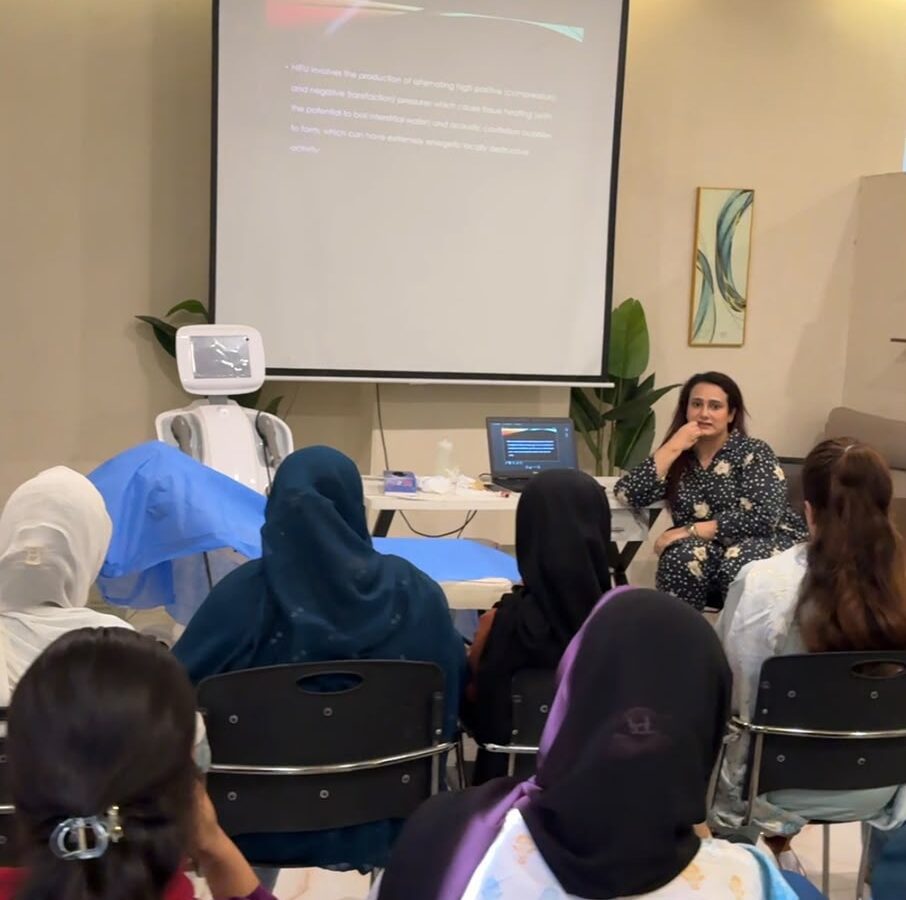
Cosmothetics Academy currently states that students receive theory followed by practical work on live models under faculty supervision.
Practical training may help students understand:
- Equipment handling
- Treatment preparation
- Patient/client positioning
- Hygiene
- Communication
- Technique
- Treatment sequencing
- Aftercare
The amount and type of practical training should always be confirmed before enrollment.
Why Hygiene and Safety Matter
Aesthetic procedures can involve direct contact with the skin and, in some cases, needles or other equipment.
Therefore, students should learn:
- Hand hygiene
- Equipment disinfection
- Personal protective equipment
- Safe handling of treatment devices
- Sharps safety where applicable
- Cross-contamination prevention
- Treatment-room preparation
- Appropriate waste disposal
- Emergency awareness
- Client/patient aftercare
Safety should be a core part of any serious aesthetics curriculum rather than an optional topic.
Who Can Join Aesthetic Dermatology Courses in Pakistan?
Eligibility depends on the specific course.
Beauty and Skincare Professionals
Non-invasive courses can be relevant to beauty therapists, aestheticians and skincare professionals seeking to expand their technical knowledge.
Medical and Paramedical Professionals
Healthcare professionals may have access to additional advanced training, depending on their qualifications and the course requirements.
Beginners
Some introductory aesthetics programs may accept beginners.
However, beginners should not assume that completing an aesthetics certificate automatically gives them the legal authority to perform medical procedures.
Cosmothetics Academy currently states that its non-invasive diploma is open to beauty and skincare professionals, while invasive and injectable modules require medical or paramedical qualifications.
Aesthetic Course vs. Medical Dermatology Qualification
This is one of the most important distinctions for prospective students.
A private aesthetics course may teach specific skills, techniques or technologies.
A recognized medical qualification follows a different educational and regulatory pathway.
For example, HEC’s current Allied Health Sciences curriculum includes a formal BS Aesthetic and Skin Care Technology framework with defined degree requirements, including 138 credit hours, internship/field experience and a capstone project.
Therefore, students should carefully check whether a program is:
- A short course
- A certificate course
- A diploma
- A university degree
- A postgraduate medical qualification
- Professional development training
These terms should not be treated as interchangeable.
Is an Aesthetic Course the Same as a Dermatology Degree?
No.
An aesthetic course does not automatically equal a dermatology degree or specialist medical qualification.
If your goal is to become a dermatologist, you need to follow the appropriate recognized medical education and postgraduate training pathway.
If your goal is to develop professional skills in skincare and aesthetic procedures, an appropriate aesthetics course may be relevant depending on your existing qualification and career objectives.
This distinction is also important because HEC has specifically cautioned against unapproved clinical degree and diploma programs involving fields such as dermatology and aesthetics.
How to Choose Aesthetic Dermatology Courses in Pakistan
Before enrolling, compare courses carefully.
Check the Curriculum
Ask for a complete syllabus.
Look for clear information about:
- Modules
- Practical sessions
- Assessment
- Equipment
- Treatment techniques
- Safety
- Eligibility
Check Trainer Backgrounds
Find out who teaches the course and whether their qualifications match the subjects they teach.
Ask About Practical Training
Find out whether practical training involves demonstrations only or supervised hands-on practice.
Confirm Eligibility
Some advanced procedures require a medical or paramedical background.
Understand the Certificate
Ask exactly what qualification or certificate you will receive and who issues it.
Do not assume that a private course certificate is equivalent to a government-recognized university degree or regulated medical qualification.
Check the Course Scope
Make sure the course matches your professional goals.
Aesthetic Dermatology Courses at Cosmothetics Academy
Cosmothetics Academy is based in Lahore and currently presents itself as an aesthetics training institute offering non-invasive, invasive and cosmetology education.
Its current course information includes a Non-Invasive Aesthetics Diploma, with subjects such as chemical peels, HydraFacial and microneedling. It also lists an Invasive & Injectables Diploma covering areas such as PRP, PRGF, regenerative therapy and dermal fillers, with medical or paramedical qualification requirements for invasive/injectable modules.
The academy’s listed Lahore campus is at:
3rd Floor, 1, Mall 2, Eden Canal Villas, Lahore
The current website lists:
Phone: +92 324 9150000
What Makes Practical Aesthetic Education Useful?
A structured program can help learners connect theoretical knowledge with practical situations.
For example, a student may learn:
Skin theory → Skin assessment → Treatment selection → Procedure preparation → Technique → Aftercare
This approach can help develop a more systematic understanding of aesthetic practice.
Students can also learn how to communicate with clients or patients about realistic treatment expectations, possible risks and aftercare.
Career Opportunities After Aesthetic Training
Career options depend heavily on the student’s existing qualifications and local requirements.
Depending on education and scope of practice, learners may develop skills relevant to:
- Aesthetic clinics
- Dermatology-related settings
- Beauty and skincare businesses
- Wellness environments
- Cosmetic industry roles
- Skincare consultation
- Beauty therapy
- Aesthetic technology support
- Further professional education
Healthcare professionals may have additional career pathways compared with non-medical beauty professionals.
An aesthetic course should therefore be viewed as professional education rather than a guarantee of employment or independent clinical practice.
Why Continuous Learning Matters in Aesthetics
Aesthetic technology changes quickly.
New devices, techniques, products and treatment protocols continue to appear. Professionals can benefit from continuing education that helps them stay familiar with:
- Updated technologies
- Safety principles
- Skin assessment
- Product knowledge
- Treatment protocols
- Client communication
- Professional ethics
HEC describes continuing development of academic curricula in response to technological advancements and changing professional needs.
Aesthetic Dermatology Courses in Lahore for Students Across Pakistan
Although the target keyword is national, Lahore is an important training location for students looking for aesthetic education.
Cosmothetics Academy’s campus is located in Eden Canal Villas, Lahore, and its website promotes admissions for students interested in aesthetic medicine and related training.
Students traveling from other cities should consider:
- Accommodation
- Class schedule
- Practical hours
- Course duration
- Total fees
- Equipment access
- Trainer availability
- Certification details
- Eligibility requirements
These details can vary between programs, so confirm the current prospectus before enrollment.
Frequently Asked Questions
1. What are aesthetic dermatology courses in Pakistan?
Aesthetic dermatology courses are educational programs covering skincare, skin analysis, aesthetic technologies and selected cosmetic procedures. The curriculum and eligibility vary according to the course level and provider.
2. Who can join aesthetic dermatology courses in Pakistan?
Eligibility depends on the program. Introductory and non-invasive courses may accept skincare and beauty professionals, while advanced invasive or injectable training may require a medical or paramedical qualification.
3. Is an aesthetic course the same as a dermatology degree?
No. An aesthetic course is not automatically equivalent to a medical degree or recognized dermatology specialization.
4. Can beginners join aesthetic courses?
Some introductory programs accept beginners. However, eligibility should be checked before enrollment because advanced procedures may have additional qualification requirements.
5. What do aesthetic dermatology courses teach?
Depending on the curriculum, subjects may include skin anatomy, skin analysis, chemical peels, microneedling, facial treatments, laser technology, skin rejuvenation, hygiene, consultation and selected advanced aesthetic procedures.
6. Do aesthetic courses include practical training?
Some programs include supervised practical training. Cosmothetics Academy states that its training combines theory with practical work and supervised practice on live models.
7. Can an aesthetic course make me a dermatologist?
No. Completing an aesthetic course does not make someone a dermatologist. Dermatology is a medical specialty requiring the appropriate recognized medical education and postgraduate training.
8. Are invasive aesthetic procedures included in every course?
No. Invasive procedures are generally subject to different eligibility and professional requirements. Cosmothetics Academy states that its invasive and injectable modules require a medical or paramedical qualification.
9. What is the difference between an aesthetic certificate and a degree?
A certificate generally documents completion of a particular training program. A degree is a formal academic qualification awarded under a recognized higher-education framework. They should not be treated as equivalent.
10. How do I choose an aesthetic course in Pakistan?
Compare the syllabus, eligibility, trainer qualifications, practical training, assessment method, certification, safety content and the program’s regulatory status where applicable.
11. Can aesthetic training help with a career in skincare?
It can develop relevant knowledge and technical skills, but career opportunities depend on the learner’s existing qualifications, experience, employer requirements and applicable professional regulations.
12. Does Cosmothetics Academy offer aesthetic training in Lahore?
Yes. Cosmothetics Academy currently offers aesthetics training at its Lahore campus, including non-invasive and advanced aesthetics programs.
13. Where is Cosmothetics Academy located?
The academy’s website lists its campus at 3rd Floor, 1, Mall 2, Eden Canal Villas, Lahore.
14. Do I need a medical background for aesthetic courses?
Not necessarily. Requirements depend on the course. Cosmothetics Academy states that its non-invasive diploma is open to beauty and skincare professionals, while invasive and injectable modules require a medical or paramedical qualification.
Final Thoughts
Choosing among aesthetic dermatology courses in Pakistan requires more than comparing course names or certificates. Students should look at the curriculum, practical training, trainer qualifications, eligibility requirements, certification and the distinction between aesthetic education and regulated medical qualifications.
For learners interested in Lahore-based aesthetics education, Cosmothetics Academy currently offers non-invasive and advanced aesthetics training with a practical component. Its published course information also distinguishes non-invasive education from invasive and injectable training according to learner qualifications.
The most appropriate course will depend on your existing background and the type of aesthetic work you intend to pursue.